Market View October
A Fed Mini-Cycle, the AI Boom and a Bull Market Still Intact
created by Maximilian Mantler, Deputy Chief Investment Officer
-
The Fed, AI and a Bruised but Intact ...Market View 2026
-
Shock, Resilience, and Resolution: Na...Market View April 2026
-
Geopolitics Increase Volatility – Fun...Market View March 2026
-
Markets, Volatility & Productivit...Market View February 2026
-
Goldilocks First, Overheating Later —...Market View January 2026
-
Dovish Fed Pivot, Labor Softening &am...Market View December 2025
-
The AI Supercycle, Fed Easing & a...Market View November 2025
-
Skepticism Fuels the Bull: Under-Owne...Market View October 2025
-
AI Momentum, Fed Shift, Inflation WatchMarket View September 2025
-
Rally Faces Headwinds: Markets Remain...Market View August 2025
-
The return of Goldilocks is taking shapeMarket View July 2025
-
Resilient stock markets have more roo...Market View June 2025
-
Markets Recover Despite Fragile Senti...Market View May 2025
-
US Tariffs and Their Impact: Risks fo...Market View April 2025
-
Market Upheaval: US Protectionism and...Market View March 2025
-
Markets on the move: Volatility, AI c...Market View February 2025
-
After the Rally: Market Volatility an...Market View January 2025
-
Positive momentum and US exceptionali...Market View December 2024
-
Resilient US growth amid election unc...Market View November 2024
Executive Summary
The bull market remains intact, although one of its pillars is cracking. In July, we judged this rally against three tests: no bubble, no recession, and supportive Fed policy. The first two still pass comfortably. The third is showing cracks: the Federal Reserve has moved from rate cuts to rate hikes, and markets anticipate a short hiking cycle – a “mini-cycle”.
The US economy is running at two speeds. Growth comes mainly from the AI buildout, while consumers and housing weaken under sticky inflation and higher rates. Corporate earnings remain the anchor: twelve-month forward earnings estimates for the S&P 500 are up 30% year-to-date – the second-best year on record. As the third-quarter earnings season gets under way, we expect company fundamentals to take over from macro headlines as the main market driver.
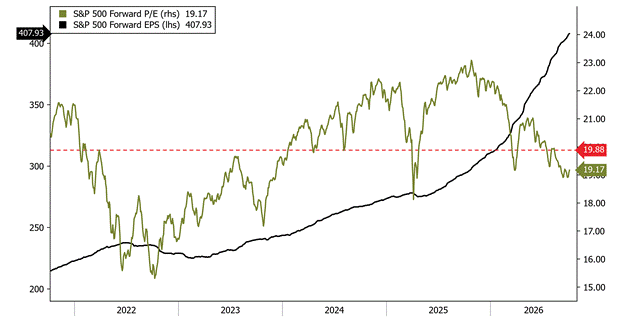
Equities have absorbed higher interest rates through valuations. The S&P 500 forward P/E has de-rated from 23x to 19x. Beneath the surface, however, breadth is the weakest since the dot-com era: the median S&P 500 stock trades 17% below its high.
Our template is 1997, when the Fed hiked once and equities moved on. The risk we take most seriously is a policy error where the Fed embarks on an extended hiking cycle. History suggests it often takes a bond tantrum for the Fed and Treasury to step in or change course. Such a moment may then be a signal to increase risk again.
Regarding our positioning, we remain overweight in equities but have slightly reduced our exposure. We keep duration short, watch credit as the canary in the coal mine, and rely on gold and alternative investments as sources of diversification. Recently, we added two-year US and German government bonds to lock in today’s elevated yields.
Market Review – Third Quarter 2026
The third quarter was defined by a sharp repricing of interest rates. Since February, market pricing has swung from three Fed rate cuts to more than four hikes. Two-year and ten-year US Treasury yields rose by around 70 basis points to 4.80% and 5.30%, respectively. US inflation has proven sticky: CPI stands at 3.4%, core PCE at 3.0%, and producer prices accelerated to 5.4%.
Equity markets absorbed this shock better than many expected – because earnings kept rising. Third-quarter earnings growth for the S&P 500 is expected at 27% year-on-year, the third straight quarter above 25%. Unusually, analysts raised their estimates during the quarter rather than cutting them. Among the early reporters, most companies in the S&P 500 have beaten earnings expectations.
Yet market leadership has become narrow. Four mega caps delivered more than 200% of the S&P 500’s third-quarter gain, while the top five stocks now make up approximately 30% of the index. Since mid-August, the equal-weighted S&P 500 has fallen 5%, compared with flat performance for the cap-weighted index – a pattern typical of midterm years. Rate-sensitive sectors such as utilities, materials and real estate saw their valuations de-rate sharply.
Across other asset classes, the picture was mixed. Oil was volatile: after falling sharply to around USD 70 per barrel at the end of the second quarter, crude rose as high as USD 110 in the third quarter amid renewed escalation in the Middle East. It currently trades around USD 100, while oil products such as diesel and gasoline reached new highs. With Gulf shipments back near pre-war levels, there are signs that crude may have peaked; the bottleneck has shifted to refined products. Gold remained under pressure from high real yields, although we still expect new all-time highs before this cycle ends. The US dollar surged, leaving the euro the most oversold since 2015; until the dollar peaks, risk appetite is likely to stay capped. In Europe, the yield spread between ten-year French and German government bonds widened to around 140 basis points, the widest since the euro crisis of 2011–12. In high yield, stress among the weakest borrowers is spreading to single-B issuers – credit remains the canary we watch most closely.
The three pillars revisited
In our July edition, we described this bull market as resting on three pillars. A quarter later, two of them stand firmly – and the third is now being tested.
The first pillar: no bubble. The equity correction of recent months has been a valuation story, not an earnings story. The S&P 500 forward P/E fell from its high of 23x to 19x, sitting below its five-year average of approximately 20x. Twelve-month forward earnings estimates rose 30% this year. Without a prior drawdown, forward earnings have risen 37% over the past twelve months – unprecedented in the data since 1991. Put differently, equities have been correcting all year – on valuations rather than on prices. Should the market move sideways until year-end, the de-rating could exceed 20%, a sizeable correction by historical standards. Overall, the market is no longer expensive.
Source: Bloomberg
Earnings quality is high as well. Positive company guidance outnumbers negative guidance by 72 to 44. Interest coverage for the S&P 500 is near a record at 14x, compared with a long-term average of 11x, and equity issuance remains low relative to market capitalization.
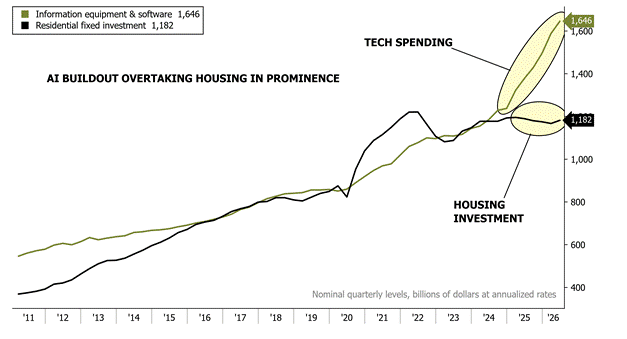
The second pillar: no recession. The US economy is K-shaped. On one side, the AI-driven buildout of data centers is booming. Core capital goods orders are up 15% year-on-year. Purchasing managers’ indices are firmly in expansion and rising – the US composite stands at 58.4, the Eurozone at 53.1 and China at 52.4. On the other side, consumers are gloomy and housing is weak. The labor market is cooling, not cracking: September payrolls rose by only 29,000, and unemployment ticked up to 4.2%.
Source: 3Fourteen Research, FINAD
The third pillar: supportive Fed policy. This is the pillar that has cracked. In July, we warned of a repeat of 2018, when a new Fed chair overtightened in a midterm year. With inflation sticky and the economy strong, the Fed has since begun to hike. Yet higher rates barely touch the AI buildout; they mainly hit the parts of the economy that are already weak, such as housing. Monetary policy thus deepens the K-shape. Whether this remains a short mini-cycle or turns into a full tightening cycle will, in our view, decide the path of the equity market over the coming months.
A mini-cycle, not a full cycle – the 1997 template
The Fed has shifted from cuts to hikes. Its own projections, however, set a high bar for more than two hikes: the FOMC sees core PCE inflation at 3.4% and unemployment at 4.1% for years to come. Two influential committee members, John Williams and Philip Jefferson, are already urging patience on the next move. Until recently, markets priced the probability of an October hike at around 70%; it has since fallen to around 20%. A December hike, however, remains largely priced in.
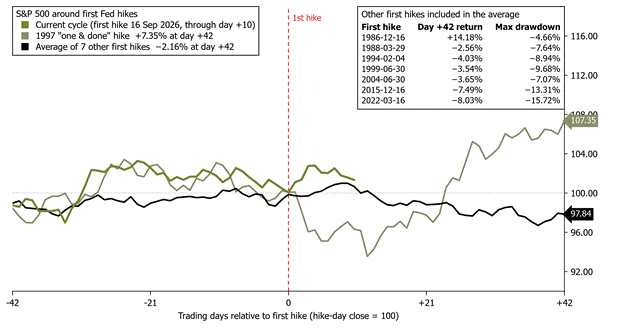
History shows that equities usually struggle early in a hiking cycle. The notable exception is 1997, when the Fed hiked only once. Back then, the S&P 500 was 7% higher 42 trading days after the hike – compared with an average decline of around 2% after other first hikes. For now, we still expect a path similar to 1997. In our base case, the Fed hikes perhaps once more, in December. After that, the task forces set up by Fed Chair Kevin Warsh are due to report, and we expect them to emphasize productivity gains and technology-driven disinflation – which could mark the end of the hiking cycle.
Source: 3Fourteen Research, FINAD
Why are yields rising?
The cyclical drivers are clear: a strong economy and sticky inflation. But structural factors matter just as much:
- Growing worries about fiscal sustainability
- Weaker demand for long-dated Treasuries from institutions and households
- Record bond issuance by the hyperscalers, crowding out demand for government bonds
- An unwinding yen carry trade, as Japanese investors repatriate capital from foreign bonds
Rates close to fair value?
We see two-year yields close to fair value at 4.75–4.85% and ten-year yields at 5.25–5.50%. The two-year yield already trades around 90 basis points above the Fed funds rate, compared with around 50 basis points on average before past hiking cycles – much of the tightening is priced in. We would not rule out an overshoot of the ten-year yield toward 6%, the new “magnet”. Based on nominal GDP growth of 6.6%, a simple regression puts fair value for the ten-year yield at around 5.8%. In a full hiking cycle, the two-year yield would typically keep rising; in a short one, it should drift lower from today’s elevated level.
Many investors ask at which yield level equities would break. We believe it is considerably higher than many expect: valuations have already compressed, earnings remain strong, and rising rates barely affect the technology sector. Remarkably, Big Tech has become the market’s refuge in this rising-rate environment.
Should yields keep spiking, we expect policymakers to step in. Possible tools include Treasury buybacks funded from the Treasury’s cash account, bank deregulation, yield-curve control, or a new Fed–Treasury accord to defend moderate long-term rates. Ahead of the midterm elections, the incentive to cap long-term rates is high. At the same time, heavy short positioning in ten-year Treasuries could trigger a sharp short-covering rally. Such a policy backstop would, in our view, be structurally bullish for equities, gold and Bitcoin.
AI – still the engine
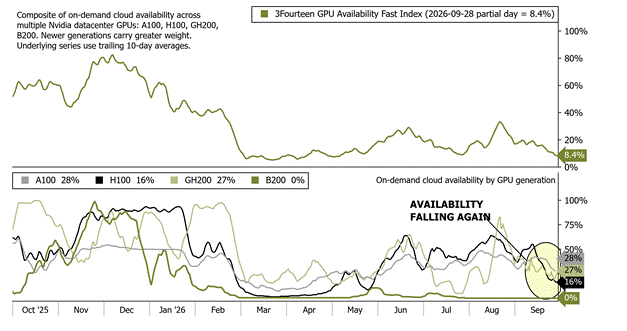
We expect AI and technology to stay in the lead. Micron’s very strong recent results confirmed that AI capital spending continues and that demand for chips still exceeds supply. The most telling signals come from the market for computing power: AI chips remain scarce, and their price keeps rising. Availability of Nvidia’s B200 processors through cloud providers has fallen to zero, while GPU rental rates are up 31% year-to-date. Amazon Web Services has raised its prices for reserved GPU capacity for the fourth straight quarter, most recently by 15%. Demand for older GPU generations, which softened over the summer, has picked up again. One explanation is the new wave of consumer AI agents such as Meta’s Muse, which requires substantial computing power.
Source: 3Fourteen Research, FINAD
This demand is turning into revenue. Estimates for 2027 cloud revenues have been raised by 26% this year, and the annualized revenues of the two frontier labs, OpenAI and Anthropic, now stand at close to USD 150 billion, growing by several billion each month. We would not be surprised to see one of them go public before year-end. Rising rental rates also counter the skeptics’ argument that chips must be written off within two to three years without earning a return. So far, the AI buildout has been a highly profitable investment for the hyperscalers. Data center projects remain largely on schedule, although we are watching for bottleneck delays. Electricity is the next constraint: China has left the world behind in power generation, while the US will need a growing share of its capacity for data centers.
AI is also beginning to reshape the labor market. Since mid-2025, the finance and technology sectors have shed around 246,000 jobs, while all other industries added around 812,000. We expect this shift to intensify and broaden next year. In 2027, the labor market could move back into focus: if inflation fears fade, attention may shift to the employment side of the Fed’s dual mandate – potentially making the Fed more dovish again.
Positioning
The medium-term set-up remains attractive for risk assets. However, the early phase of a hiking cycle, an unusually narrow market and the risk of a policy error argue for more caution in the near term. We have therefore slightly reduced our significant overweight in equities. We remain overweight, but less so than before. This is a risk-management step, not a change in our constructive view. On balance, we continue to give the bull market the benefit of the doubt.
Several factors support staying invested. Earnings quality is high, and seasonality is favorable: historically, equities have rallied in the fourth quarter of a midterm year and continued to do so in the first and second quarters of the following year. Positioning is cautious – net exposure of US hedge funds is low and only 28% of S&P 500 stocks trade above their 50-day average. From a contrarian perspective, this leaves room for a broadening rally.
We see the range of outcomes as wide:
- Bull case: The Fed stops after two hikes, yields stabilize, valuations re-expand as the earnings boom continues, and laggards join the rally. A ceasefire in the Middle East would add a further tailwind.
- Bear case: The Fed turns more hawkish as inflation stays broad and sticky. A stumble among the largest stocks, credit contagion or renewed oil escalation – with stocks and bonds falling together – would hit the whole market.
Within equities, we continue to prefer global quality large caps with a momentum tilt, supplemented by broad ETFs and active emerging-market managers. In fixed income, we keep duration short. Gold remains our primary diversifier. Alternative investments also remain a sizeable part of our allocation: we invest in selected strategies that aim to be largely uncorrelated with equities – a valuable source of diversification in a phase of higher volatility.
Signals we watch: semiconductor stocks holding their July lows; small and mid caps – if they join banks in their decline, then growth optimism may have peaked; CCC and single-B credit spreads; the French–German bond spread; a peak in the US dollar; and the third-quarter earnings season. A bond tantrum that forces the Fed and Treasury to act could, in our view, be the signal to increase risk again.
Sources: 3Fourteen Research (Q4 2026 Chart Book), 42Macro, Bloomberg, Bank of America, BlueBay, CFTC, Citadel, Deutsche Bank, Duality Research, FactSet, Goldman Sachs, Hightower Advisors, J.P. Morgan Asset Management, Lombard Odier, Wells Fargo, and other research partners.
-
The Fed, AI and a Bruised but Intact ...Market View
-
Shock, Resilience, and Resolution: Na...Market View April
-
Geopolitics Increase Volatility – Fun...Market View March
-
Markets, Volatility & Productivit...Market View February
-
Goldilocks First, Overheating Later —...Market View January
-
Dovish Fed Pivot, Labor Softening &am...Market View December
-
The AI Supercycle, Fed Easing & a...Market View November
-
Skepticism Fuels the Bull: Under-Owne...Market View October
-
AI Momentum, Fed Shift, Inflation WatchMarket View September
-
Rally Faces Headwinds: Markets Remain...Market View August
-
The return of Goldilocks is taking shapeMarket View July
-
Resilient stock markets have more roo...Market View June
-
Markets Recover Despite Fragile Senti...Market View May
-
US Tariffs and Their Impact: Risks fo...Market View April
-
Market Upheaval: US Protectionism and...Market View March
-
Markets on the move: Volatility, AI c...Market View February
-
After the Rally: Market Volatility an...Market View January
-
Positive momentum and US exceptionali...Market View December
-
Resilient US growth amid election unc...Market View November
Disclaimer
This Publication was created with the assistance of artificial intelligence on 07.10.2026.
The information contained in this document constitutes a marketing communication from FINAD (FINAD AG, Zurich; FINAD GmbH, Vienna or FINAD GmbH, Hamburg branch). This marketing communication has not been prepared in accordance with legislation promoting the independence of investment research and is not subject to any prohibition on trading following the dissemination of investment research. This document is for general information purposes only and for the personal use of the recipient of this document (hereafter referred to as “recipient”). It does not constitute a binding offer or invitation by or on behalf of FINAD to purchase, subscribe, sell or return any investment or to invest in any particular trading strategy or to engage in any other transaction in any jurisdiction. It does not constitute a recommendation by FINAD in legal, accounting or tax matters or a representation by FINAD as to the suitability or appropriateness of any particular investment strategy, transaction or investment for any individual recipient. A reference to past performance should not be construed as an indication of the future. The information and analyses contained in this publication have been compiled from sources believed to be reliable and credible. However, FINAD makes no warranty as to their reliability or completeness and disclaims any liability for losses arising from the use of this information. All opinions and views represent estimations that were valid at the time of going to press; we reserve the right to make changes at any time without obligation to update or communicate them. Before making any investment, transaction or other financial decision, recipients should clarify the suitability of such investment, transaction or other business for their particular circumstances and independently (with their professional advisors if necessary) consider the specific risks and the legal, regulatory, credit, tax and accounting consequences. It is the responsibility of the respective recipient to verify that he/she is entitled under the law applicable in his/her country of residence and/or nationality to request, receive and use this publication for personal purposes. FINAD declines any liability in this respect. An investment in the funds and other financial instruments mentioned in this document should only be made after careful reading and examination of the latest sales prospectus, the fund regulations and the legal information contained therein and after prior consultation with your client advisor and – if necessary – your own legal and/or tax advisor. It is the responsibility of the respective recipient to check whether he is entitled to request and receive the relevant fund documents under the law applicable in his country of residence and/or nationality. Neither this document nor copies thereof may be sent to or taken into the United States or distributed in the United States or handed over to US persons.
This document may not be reproduced in part or in full without the prior written consent of FINAD.
For Switzerland: FINAD AG, Talstrasse 58, 8001 Zurich, Switzerland is a public limited company specialized in financial services and asset management, established under Swiss law. FINAD is authorised as asset manager by the Swiss Financial Market Supervisory Authority (FINMA) and supervised by the Supervisory Organization (SO) AOOS. FINAD is also associated with OFS Ombud Finance Switzerland (http://www.ombudfinance.ch). Complaints about FINAD can be addressed to SO AOOS or OFS.
For Austria: FINAD GmbH, Dorotheergasse 6-8/L021, 1010 Vienna, Austria is an investment firm according to Section 3 of the Austrian Securities Supervision Act 2018 (WAG 2018) and as such is entitled to provide investment services of investment advice, portfolio management as well as the acceptance and transmission of orders, in each case with regard to financial instruments. FINAD is not authorized to provide services that involve holding clients’ money, securities or other instruments. FINAD is subject to the supervision of the Financial Market Authority (FMA), Otto-Wagner-Platz 5, 1090 Vienna (www.fma.gv.at). Complaints about FINAD may be submitted to the FMA.
For Germany: FINAD GmbH Deutschland, Schauenburgerstraße 61, 20095 Hamburg, Germany is the German branch of FINAD GmbH, Dorotheergasse 6-8/L/021, AT-1010 Vienna, Austria. FINAD is an independent securities services company specialized in investment advice, investment brokerage and asset management (financial portfolio management). The provision of securities services by FINAD is subject to the supervision of the Financial Market Authority (FMA), Otto-Wagner-Platz 5, 1090 Vienna, Austria (www.fma.gv.at) as well as the Federal Financial Supervisory Authority (BaFin), Graurheindorfer Straße 108, 53117 Bonn, Germany and Marie-Curie-Straße 24-28, 60439 Frankfurt am Main, Germany (www.bafin.de). Complaints about FINAD can be addressed to the FMA or BaFin.
FINAD is not authorized to practice law, provide tax advice or auditing services.
© Copyright FINAD – all rights reserved.
For more details about the company, please visit https://finad.com/en/imprint.