Shock, Resilience, and Resolution: Navigating the Oil Crisis
created by Ullrich Fischer, Chief Investment Officer
-
Geopolitics Increase Volatility – Fun...Market View March 2026
-
Markets, Volatility & Productivit...Market View February 2026
-
Goldilocks First, Overheating Later —...Market View January 2026
-
Dovish Fed Pivot, Labor Softening &am...Market View December 2025
-
The AI Supercycle, Fed Easing & a...Market View November 2025
-
Skepticism Fuels the Bull: Under-Owne...Market View October 2025
-
AI Momentum, Fed Shift, Inflation WatchMarket View September 2025
-
Rally Faces Headwinds: Markets Remain...Market View August 2025
-
The return of Goldilocks is taking shapeMarket View July 2025
-
Resilient stock markets have more roo...Market View June 2025
-
Markets Recover Despite Fragile Senti...Market View May 2025
-
US Tariffs and Their Impact: Risks fo...Market View April 2025
-
Market Upheaval: US Protectionism and...Market View March 2025
-
Markets on the move: Volatility, AI c...Market View February 2025
-
After the Rally: Market Volatility an...Market View January 2025
-
Positive momentum and US exceptionali...Market View December 2024
-
Resilient US growth amid election unc...Market View November 2024
Executive Summary
Equity markets have so far followed the “classic” oil shock script, falling roughly 10% from February highs. The critical question is whether this proves to be a short, sharp disruption — like the 1990 Gulf War — or a prolonged shock like 1973 and 1979.
Both the US and Iran face a narrowing window for an off-ramp. Iran retains leverage only as long as it can credibly threaten the Strait of Hormuz — the longer it waits, the more its military capacity is degraded. Trump faces rising energy prices, a 35% approval rating, and midterm elections. He has signaled openness to a deal while keeping the threat of a final 2-3 weeklong push alive. China‘s diplomatic entry as a potential peace broker and the likely only credible security guarantor for Iran adds a further structural push toward resolution in the coming weeks in our view.
Beneath the turbulence, fundamentals have held up. Twelve-month forward earnings estimates for the S&P 500 have actually accelerated, and credit spreads have so far remained contained. Goldman Sachs has raised its recession probability to 30%, which seems fair at this point. The market continues to treat this as a temporary disruption, not the beginning of a structural downturn.
We are cautiously constructive. We trimmed equity exposure modestly in mid-March as a risk management measure but have remained overweight. The rally this week, combined with a significant increase in bearish sentiment beforehand, suggests the market may have already bottomed. Our conditions for adding risk include clear political efforts toward de-escalation, alongside a visible resumption of tanker traffic through the Strait of Hormuz and Brent crude declining convincingly below USD 100 per barrel.
Equities have rallied on each sign of de-escalation — typically early in the week — and sold off sharply whenever Trump signals the possibility of more serious escalation. With the April 6th deadline for Iran to reopen Hormuz expiring coming Monday, uncertainty is unusually high heading into the three-day Easter weekend. Trump has historically chosen to escalate when markets are closed. A diplomatic breakthrough would trigger a sharp rally; a further escalation would likely test this week’s low.
Monthly Review
March 2026 marked the first genuine oil shock since 2022. Equity markets fell roughly 10% from their highs as the Iran conflict shifted from a background geopolitical risk to a primary market driver. Despite these pressures, the MSCI World index closed the quarter down only 3.5% year-to-date in USD, showing notable resilience.
Energy prices surged. Brent crude climbed roughly 78% from early February and 52% from early March, while the US national average for gasoline exceeded USD 4 per gallon for the first time since 2022 — a politically sensitive threshold that increases pressure on Trump to pursue de-escalation. The sell-off was widespread: the Magnificent 7 declined around 6%, the Stoxx 600 fell 7.5%, and Emerging Markets dropped 13% in March. Bitcoin held up better than expected, posting modest gains.
Gold was the most notable underperformer, falling 11.5% in March with a peak drawdown of nearly 25%. It became a key source of liquidity as demand for US dollars surged during the crisis. Strong selling pressure came from Turkey, which reportedly liquidated significant reserves to support the lira. We had reduced our gold exposure earlier in the year near USD 5,100 per ounce and used the March decline to rebuild positions at more attractive levels. While volatility is likely to persist, we believe gold is now the most thoroughly reset asset class, with its long-term fundamentals intact and arguably improved by increased political uncertainty.
The most significant macro shift was a sharp tightening in financial conditions. The US Financial Conditions Index — combining interest rates, credit spreads, equities, and the dollar — reached its tightest level since June 2025, tightening at the second-fastest pace since the Fed’s 2022 hiking cycle. Such tightening typically dampens economic activity with a lag. If sustained, the shock risks evolving from an energy and inflation concern into a broader growth slowdown, increasing the likelihood of recession.
Peace Deal Window Open — China Holds the Key
We believe the most important new diplomatic variable is China. On 31st of March Chinese Foreign Minister Wang Yi and Pakistani Foreign Minister Ishaq Dar concluded talks in Beijing and published a joint five-point peace initiative calling for an immediate ceasefire, the swift start of peace negotiations, and the urgent restoration of free navigation through the Strait of Hormuz.
Beijing may be uniquely positioned to provide Iran with credible long-term security guarantees in return for reopening the Strait of Hormuz, while also being Tehran’s largest oil buyer with a strong economic stake in keeping the passage open.
Trump has indicated that the US may wrap up its involvement in the war within the next two to three weeks. In our view, both sides have compelling incentives to reach a resolution before the damage becomes irreversible.
The bull case: once the conflict ends and Hormuz begins to reopen, markets can look through the economic damage just as they do after a natural disaster whose cause is known and finite. Earnings were accelerating into the shock and medium- and long-term inflation expectations have remained anchored so far. If a deal is struck, Brent could fall USD 25-30 per barrel within days and the S&P 500 could rally back toward 7,000.
The bear case: physical buffers — strategic oil reserves, inventory drawdowns, pre-war floating storage — are finite and soon exhausted. Energy markets are steering towards a cliff where price spikes can go parabolic. If companies then respond to sustained margin pressure by cutting employment, a recessionary spiral becomes possible.
We give the advantage to the bull scenario, contingent on near-term US military disengagement, as supply chain indicators suggest the global economy can absorb a temporary shock if the conflict resolves quickly.
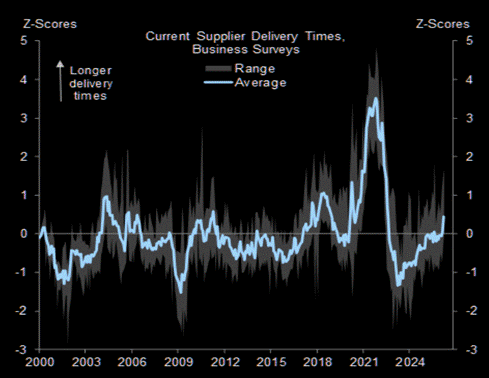
The chart below tracks global supplier delivery times expressed as Z-scores (standard deviations) — a statistical measure of how far current conditions deviate from the long-term average, where zero is normal and the 2021/22 spike of nearly +4 standard deviations reflected the full-blown pandemic supply chain crisis followed by the Ukraine invasion.
Source: Goldman Sachs
Today’s reading has ticked up modestly but remains close to zero. While the Hormuz closure is causing real disruption, it has not yet triggered the broad, embedded supply chain dislocation that prolonged the 2021-2022 inflationary episode.
Positioning
We interpret recent market weakness as a correction within an ongoing bull market. Despite a challenging backdrop — geopolitical conflict, surging oil prices, rising rates, AI uncertainty, and six months of consolidation in the Magnificent 7 — the S&P 500 is down less than 5% year-to-date. Bull markets have averaged around 5.6 years historically, while the current cycle is approximately three years old.
A correction of around 10% is typical once a year and often presents attractive entry opportunities. That said, as long as the Strait of Hormuz remains closed, downside risks could easily escalate, and this could spiral into a bear market.
Nevertheless, sentiment and positioning indicators suggest to us a low may already be forming. While a retest remains possible, our base case is that the majority of the drawdown is behind us. Put option volumes — elevated during periods of peak fear — have risen to levels historically associated with correction troughs. Investment Grade credit spreads have remained well contained; in past bear markets, they widened materially well before equities bottomed. Their current stability points to limited systemic stress.
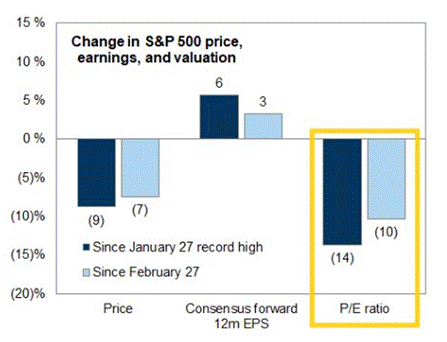
The equity sell-off has been a valuation story, not an earnings story — a distinction critical for the recovery path once uncertainty subsides. Since the 27 January peak, the S&P 500 has declined roughly 9% to its low, driven primarily by a ~14% compression in the forward P/E ratio while consensus 12-month earnings estimates have risen approximately 6% according to Goldman Sachs.
Source: Goldman Sachs, FactSet
This marks one of the sharpest valuation de-rating episodes since the Global Financial Crisis and leaves US equities more attractive.
On a sector level, technology valuations have adjusted materially, with the premium relative to the broader S&P 500 falling to a seven-year low. Nvidia now trades at roughly the same forward P/E as the index for the first time in over a decade, despite being expected to contribute approximately 21% of S&P 500 earnings growth in 2026.
A key caveat: earnings estimates typically lag market movements in sustained downturns. In 2022, estimates continued rising for months after equities had already peaked. Should Hormuz remain closed through May, downward revisions are likely to follow.
Finally, please note that, going forward, we will publish our market view on a quarterly basis, complemented by shorter ad hoc updates when market conditions warrant. We believe this approach provides greater flexibility and a clearer view of our thinking. As always, we remain available for direct discussions—either via call or email.
Sources: Bloomberg, Goldman Sachs, JP Morgan, 3Fourteen Research, Macro 42, BCA Research, Fidelity, Haver Analytics, Steno Research, The Macro Compass
-
Geopolitics Increase Volatility – Fun...Market View March
-
Markets, Volatility & Productivit...Market View February
-
Goldilocks First, Overheating Later —...Market View January
-
Dovish Fed Pivot, Labor Softening &am...Market View December
-
The AI Supercycle, Fed Easing & a...Market View November
-
Skepticism Fuels the Bull: Under-Owne...Market View October
-
AI Momentum, Fed Shift, Inflation WatchMarket View September
-
Rally Faces Headwinds: Markets Remain...Market View August
-
The return of Goldilocks is taking shapeMarket View July
-
Resilient stock markets have more roo...Market View June
-
Markets Recover Despite Fragile Senti...Market View May
-
US Tariffs and Their Impact: Risks fo...Market View April
-
Market Upheaval: US Protectionism and...Market View March
-
Markets on the move: Volatility, AI c...Market View February
-
After the Rally: Market Volatility an...Market View January
-
Positive momentum and US exceptionali...Market View December
-
Resilient US growth amid election unc...Market View November
Disclaimer
This Publication was created on 02.04.2026.
The information contained in this document constitutes a marketing communication from FINAD (FINAD AG, Zurich; FINAD GmbH, Vienna or FINAD GmbH, Hamburg branch). This marketing communication has not been prepared in accordance with legislation promoting the independence of investment research and is not subject to any prohibition on trading following the dissemination of investment research. This document is for general information purposes only and for the personal use of the recipient of this document (hereafter referred to as “recipient”). It does not constitute a binding offer or invitation by or on behalf of FINAD to purchase, subscribe, sell or return any investment or to invest in any particular trading strategy or to engage in any other transaction in any jurisdiction. It does not constitute a recommendation by FINAD in legal, accounting or tax matters or a representation by FINAD as to the suitability or appropriateness of any particular investment strategy, transaction or investment for any individual recipient. A reference to past performance should not be construed as an indication of the future. The information and analyses contained in this publication have been compiled from sources believed to be reliable and credible. However, FINAD makes no warranty as to their reliability or completeness and disclaims any liability for losses arising from the use of this information. All opinions and views represent estimations that were valid at the time of going to press; we reserve the right to make changes at any time without obligation to update or communicate them. Before making any investment, transaction or other financial decision, recipients should clarify the suitability of such investment, transaction or other business for their particular circumstances and independently (with their professional advisors if necessary) consider the specific risks and the legal, regulatory, credit, tax and accounting consequences. It is the responsibility of the respective recipient to verify that he/she is entitled under the law applicable in his/her country of residence and/or nationality to request, receive and use this publication for personal purposes. FINAD declines any liability in this respect. An investment in the funds and other financial instruments mentioned in this document should only be made after careful reading and examination of the latest sales prospectus, the fund regulations and the legal information contained therein and after prior consultation with your client advisor and – if necessary – your own legal and/or tax advisor. It is the responsibility of the respective recipient to check whether he is entitled to request and receive the relevant fund documents under the law applicable in his country of residence and/or nationality. Neither this document nor copies thereof may be sent to or taken into the United States or distributed in the United States or handed over to US persons.
This document may not be reproduced in part or in full without the prior written consent of FINAD.
For Switzerland: FINAD AG, Talstrasse 58, 8001 Zurich, Switzerland is a public limited company specialized in financial services and asset management, established under Swiss law. FINAD is authorised as asset manager by the Swiss Financial Market Supervisory Authority (FINMA) and supervised by the Supervisory Organization (SO) AOOS. FINAD is also associated with OFS Ombud Finance Switzerland (http://www.ombudfinance.ch). Complaints about FINAD can be addressed to SO AOOS or OFS.
For Austria: FINAD GmbH, Dorotheergasse 6-8/L021, 1010 Vienna, Austria is an investment firm according to Section 3 of the Austrian Securities Supervision Act 2018 (WAG 2018) and as such is entitled to provide investment services of investment advice, portfolio management as well as the acceptance and transmission of orders, in each case with regard to financial instruments. FINAD is not authorized to provide services that involve holding clients’ money, securities or other instruments. FINAD is subject to the supervision of the Financial Market Authority (FMA), Otto-Wagner-Platz 5, 1090 Vienna (www.fma.gv.at). Complaints about FINAD may be submitted to the FMA.
For Germany: FINAD GmbH Deutschland, Schauenburgerstraße 61, 20095 Hamburg, Germany is the German branch of FINAD GmbH, Dorotheergasse 6-8/L/021, AT-1010 Vienna, Austria. FINAD is an independent securities services company specialized in investment advice, investment brokerage and asset management (financial portfolio management). The provision of securities services by FINAD is subject to the supervision of the Financial Market Authority (FMA), Otto-Wagner-Platz 5, 1090 Vienna, Austria (www.fma.gv.at) as well as the Federal Financial Supervisory Authority (BaFin), Graurheindorfer Straße 108, 53117 Bonn, Germany and Marie-Curie-Straße 24-28, 60439 Frankfurt am Main, Germany (www.bafin.de). Complaints about FINAD can be addressed to the FMA or BaFin.
FINAD is not authorized to practice law, provide tax advice or auditing services.
© Copyright FINAD – all rights reserved.
For more details about the company, please visit https://finad.com/en/imprint.