Market View March
Geopolitics Increase Volatility – Fundamentals Remain Constructive
created by Maximilian Mantler, Deputy Chief Investment Officer
-
Markets, Volatility & Productivit...Market View February 2026
-
Goldilocks First, Overheating Later —...Market View January 2026
-
Dovish Fed Pivot, Labor Softening &am...Market View December 2025
-
The AI Supercycle, Fed Easing & a...Market View November 2025
-
Skepticism Fuels the Bull: Under-Owne...Market View October 2025
-
AI Momentum, Fed Shift, Inflation WatchMarket View September 2025
-
Rally Faces Headwinds: Markets Remain...Market View August 2025
-
The return of Goldilocks is taking shapeMarket View July 2025
-
Resilient stock markets have more roo...Market View June 2025
-
Markets Recover Despite Fragile Senti...Market View May 2025
-
US Tariffs and Their Impact: Risks fo...Market View April 2025
-
Market Upheaval: US Protectionism and...Market View March 2025
-
Markets on the move: Volatility, AI c...Market View February 2025
-
After the Rally: Market Volatility an...Market View January 2025
-
Positive momentum and US exceptionali...Market View December 2024
-
Resilient US growth amid election unc...Market View November 2024
Executive Summary
Equity markets are consolidating at a high level following the strong rally of recent months. At the same time, dispersion has increased significantly, as the discussion about the economic impact of artificial intelligence has led to strong price movements at the individual stock level.
The military conflict between the United States, Israel, and Iran is bringing geopolitical risks into focus for the markets. The closure of the Strait of Hormuz has significant implications for energy prices, inflation, and economic growth.
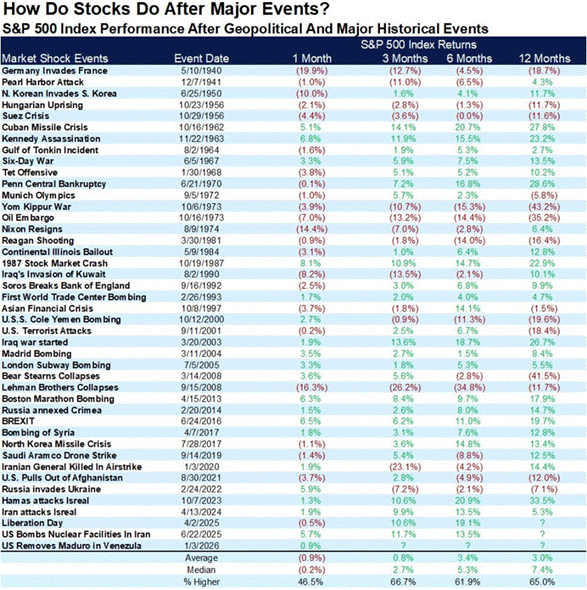
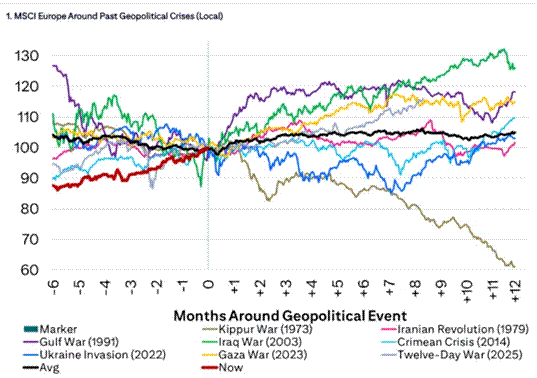
However, historical experience shows that geopolitical escalations usually represent temporary market shocks. Both U.S. and European equity markets have often recovered losses relatively quickly after such events in the past.
The macroeconomic environment remains promising. A recession currently appears unlikely. Rather, economic momentum is showing the first signs of acceleration and corporate earnings are developing robustly.
In our positioning, we remain structurally constructive on risk assets, although we expect increased volatility in the short term. We used the recent market weakness to build a position in Japanese equities, while gold continues to play an important role as a portfolio diversifier.
Monthly Review
Equity markets consolidated at a high level. After the strong rally of recent months, many indices recently moved sideways near their record highs. Beneath the surface, however, so-called dispersion increased. While some stocks rose sharply, others declined significantly. The reason for this was the dominant theme of February: artificial intelligence (AI).
Triggered by remarkable advances in Anthropic’s AI model “Claude,” fears emerged that one industry after another could undergo structural transformation. Initially, software stocks were primarily sold off, such as ServiceNow or Adobe. AI could enable companies to develop software themselves rather than purchasing it at high cost. Soon after, booking platforms such as Booking.com and logistics companies like Kühne & Nagel were also affected. AI could make the need for intermediaries obsolete, whether in tourism or logistics. Mere announcements were enough to wipe out billions in company valuations.
Due to these uncertainties regarding the development of AI, stocks in the technology sector and the U.S.—where many large technology companies are based—performed worse in February than more defensive sectors and Europe. Put somewhat bluntly, there is no European software industry and therefore no companies that could be disrupted by a newer technology, namely AI. Clear beneficiaries continued to be suppliers involved in the construction of data centers.
The sell-off among software companies also drew attention to another market: many of these firms have been heavily financed in recent years by private credit funds. The limitation of redemptions at a fund managed by asset manager Blue Owl, as well as the sale of loans totaling around USD 1.4 billion, highlight potential liquidity risks. The market has grown significantly in recent years and has become increasingly concentrated among a few large direct lenders. Although no systemic crisis is currently apparent, the combination of high leverage, sector concentration, and limited transparency could increase risks should the economic environment deteriorate.
The reporting season for the fourth quarter of 2025 is nearly complete. Strong earnings growth of 15% year-on-year underscores the continued excellent fundamental momentum in the United States. In Europe, earnings growth stands at just under 7%, and in emerging markets at 17%.
At the end of February, the U.S. Supreme Court declared the IEEPA tariffs imposed by U.S. President Donald Trump invalid (IEEPA = International Emergency Economic Powers Act). In response, Trump enacted a legally permissible general tariff rate of 10% for a period of 150 days. Markets are largely looking through these new tariffs. Trump’s room for maneuver and threat potential were significantly restricted by the ruling.
While macroeconomic topics received little attention during February, that changed dramatically with the outbreak of the Iran war.
Geopolitical escalations are usually temporary market shocks
The military conflict between the United States, Israel, and Iran is currently dominating market developments. The focus is on global energy supply and therefore on inflation and economic growth.
At the center of this development lies the Strait of Hormuz—one of the most important maritime trade routes for crude oil and natural gas. Around 20% of global crude oil and LNG shipments pass through this narrow waterway (LNG = liquefied natural gas). The main exporters in this region are Saudi Arabia, Iraq, the United Arab Emirates, Kuwait, Iran, and Qatar (particularly for LNG). On the demand side, most of this oil flows to Asia, especially to China, India, Japan, and South Korea. Europe is also an important buyer, particularly of gas supplies.
A prolonged disruption of these energy flows could have noticeable effects on global energy markets. Various analyses show that a short disruption of one to two weeks could push the oil price to USD 80 to 90 per barrel, even if part of the supply is redirected through alternative pipelines. In the case of a longer disruption, the price could rise toward USD 110 per barrel.
The gas market would also be significantly affected. If LNG transport through the strait were to be completely disrupted for a month, European gas prices could rise to around EUR 70/MWh or more according to estimates—a level last reached during the European energy crisis of 2022, which triggered substantial demand adjustments. However, gas prices would not rise to the previous peak of EUR 350/MWh seen at that time.
In a scenario of a prolonged disruption, inflation could increase by around 0.8% in the United States and by 1.1% in the Eurozone, according to Bloomberg (latest inflation figures: U.S. 2.4%, Eurozone 1.9%). Economic growth could be about 0.1% lower in the United States and around 0.6% lower in the Eurozone (latest growth forecasts: U.S. 2.5%, Eurozone 1.5%). Both regions should be able to absorb the energy shock without falling into recession. However, the Eurozone clearly starts from a weaker position.
It should not be underestimated that there is considerable global political interest in reopening the strait as quickly as possible. U.S. President Donald Trump has stated that state-backed insurance for tankers as well as military escorts should be introduced as soon as possible. Even China—one of Iran’s most important political supporters—has publicly called for free and secure passage.
For equity markets, history shows a relatively clear pattern: geopolitical shocks initially lead to increased volatility and price declines. However, the experience of recent decades shows that such events generally do not have a lasting impact on the long-term trend of equity markets. Historical data show that U.S. equity markets have usually been able to recover their losses relatively quickly after geopolitical escalations and have often gone on to reach new highs.
Quelle: Carson Investment Research
A similar pattern can also be observed in Europe. Although European economies are more dependent on energy imports from the Middle East than the United States, European equity markets have also generally been able to absorb geopolitical crises relatively quickly in the past and return to their previous growth trajectory over the long term. For investors, this means that geopolitical conflicts may create significant short-term uncertainty, but rarely change the structural drivers of global equity markets over the long run.
Quelle: Morgan Stanley
Positioning
In the short term, we expect a volatile phase due to the Iran war. However, in our base case we assume that the conflict will calm down in the coming weeks. We do not expect a recession and continue to assess the macroeconomic environment as promising: rising expectations for corporate earnings, signs of economic acceleration according to purchasing managers’ indices, and a normalization of market sentiment.
We used the recent market weakness to build a small position in Japanese equities. Japan is currently benefiting from a structural shift: after decades of deflation, a moderate inflation environment with rising wages and higher corporate profits is increasingly taking hold. At the same time, reforms at the Tokyo Stock Exchange are improving corporate capital discipline and leading to higher share buybacks and dividends. Despite these positive developments, Japanese equities remain attractively valued in an international comparison and therefore offer an appealing risk-reward profile.
We are convinced that AI will lead to major changes. AI will reshape industries and create winners as well as losers. Some software companies have probably been punished too severely, but for the time being we are waiting to see how developments unfold. We also remain cautious with regard to private credit.
Due to uncertainties surrounding AI, the consensus trade in recent weeks has been: out of the United States and into other markets. Valuations of the Magnificent 7 have declined significantly. Despite outstanding corporate results, Nvidia is currently trading at a forward P/E of around 22—a level last seen during the major tariff announcements last year (“Liberation Day”) or in the fourth quarter of 2018, when AI was not yet a market theme. In our view, the pain trade would be a tech rally led by the Magnificent 7.
Gold remains our most important portfolio diversifier. In the current environment, gold has once again demonstrated its stability. Commodities in general serve as a hedge against potential inflation surprises.
Bitcoin may have found a bottom. Contrary to many fears, its price did not decline further during the Iran war.
Corporate bonds have for some time offered only a small yield spread over government bonds. Should this change due to the turbulent market environment, we could increase our positioning in this asset class.
-
Markets, Volatility & Productivit...Market View February
-
Goldilocks First, Overheating Later —...Market View January
-
Dovish Fed Pivot, Labor Softening &am...Market View December
-
The AI Supercycle, Fed Easing & a...Market View November
-
Skepticism Fuels the Bull: Under-Owne...Market View October
-
AI Momentum, Fed Shift, Inflation WatchMarket View September
-
Rally Faces Headwinds: Markets Remain...Market View August
-
The return of Goldilocks is taking shapeMarket View July
-
Resilient stock markets have more roo...Market View June
-
Markets Recover Despite Fragile Senti...Market View May
-
US Tariffs and Their Impact: Risks fo...Market View April
-
Market Upheaval: US Protectionism and...Market View March
-
Markets on the move: Volatility, AI c...Market View February
-
After the Rally: Market Volatility an...Market View January
-
Positive momentum and US exceptionali...Market View December
-
Resilient US growth amid election unc...Market View November
Disclaimer
This Publication was created on 05.03.2026.
The information contained in this document constitutes a marketing communication from FINAD (FINAD AG, Zurich; FINAD GmbH, Vienna or FINAD GmbH, Hamburg branch). This marketing communication has not been prepared in accordance with legislation promoting the independence of investment research and is not subject to any prohibition on trading following the dissemination of investment research. This document is for general information purposes only and for the personal use of the recipient of this document (hereafter referred to as “recipient”). It does not constitute a binding offer or invitation by or on behalf of FINAD to purchase, subscribe, sell or return any investment or to invest in any particular trading strategy or to engage in any other transaction in any jurisdiction. It does not constitute a recommendation by FINAD in legal, accounting or tax matters or a representation by FINAD as to the suitability or appropriateness of any particular investment strategy, transaction or investment for any individual recipient. A reference to past performance should not be construed as an indication of the future. The information and analyses contained in this publication have been compiled from sources believed to be reliable and credible. However, FINAD makes no warranty as to their reliability or completeness and disclaims any liability for losses arising from the use of this information. All opinions and views represent estimations that were valid at the time of going to press; we reserve the right to make changes at any time without obligation to update or communicate them. Before making any investment, transaction or other financial decision, recipients should clarify the suitability of such investment, transaction or other business for their particular circumstances and independently (with their professional advisors if necessary) consider the specific risks and the legal, regulatory, credit, tax and accounting consequences. It is the responsibility of the respective recipient to verify that he/she is entitled under the law applicable in his/her country of residence and/or nationality to request, receive and use this publication for personal purposes. FINAD declines any liability in this respect. An investment in the funds and other financial instruments mentioned in this document should only be made after careful reading and examination of the latest sales prospectus, the fund regulations and the legal information contained therein and after prior consultation with your client advisor and – if necessary – your own legal and/or tax advisor. It is the responsibility of the respective recipient to check whether he is entitled to request and receive the relevant fund documents under the law applicable in his country of residence and/or nationality. Neither this document nor copies thereof may be sent to or taken into the United States or distributed in the United States or handed over to US persons.
This document may not be reproduced in part or in full without the prior written consent of FINAD.
For Switzerland: FINAD AG, Talstrasse 58, 8001 Zurich, Switzerland is a public limited company specialized in financial services and asset management, established under Swiss law. FINAD is authorised as asset manager by the Swiss Financial Market Supervisory Authority (FINMA) and supervised by the Supervisory Organization (SO) AOOS. FINAD is also associated with OFS Ombud Finance Switzerland (http://www.ombudfinance.ch). Complaints about FINAD can be addressed to SO AOOS or OFS.
For Austria: FINAD GmbH, Dorotheergasse 6-8/L021, 1010 Vienna, Austria is an investment firm according to Section 3 of the Austrian Securities Supervision Act 2018 (WAG 2018) and as such is entitled to provide investment services of investment advice, portfolio management as well as the acceptance and transmission of orders, in each case with regard to financial instruments. FINAD is not authorized to provide services that involve holding clients’ money, securities or other instruments. FINAD is subject to the supervision of the Financial Market Authority (FMA), Otto-Wagner-Platz 5, 1090 Vienna (www.fma.gv.at). Complaints about FINAD may be submitted to the FMA.
For Germany: FINAD GmbH Deutschland, Schauenburgerstraße 61, 20095 Hamburg, Germany is the German branch of FINAD GmbH, Dorotheergasse 6-8/L/021, AT-1010 Vienna, Austria. FINAD is an independent securities services company specialized in investment advice, investment brokerage and asset management (financial portfolio management). The provision of securities services by FINAD is subject to the supervision of the Financial Market Authority (FMA), Otto-Wagner-Platz 5, 1090 Vienna, Austria (www.fma.gv.at) as well as the Federal Financial Supervisory Authority (BaFin), Graurheindorfer Straße 108, 53117 Bonn, Germany and Marie-Curie-Straße 24-28, 60439 Frankfurt am Main, Germany (www.bafin.de). Complaints about FINAD can be addressed to the FMA or BaFin.
FINAD is not authorized to practice law, provide tax advice or auditing services.
© Copyright FINAD – all rights reserved.
For more details about the company, please visit https://finad.com/en/imprint.